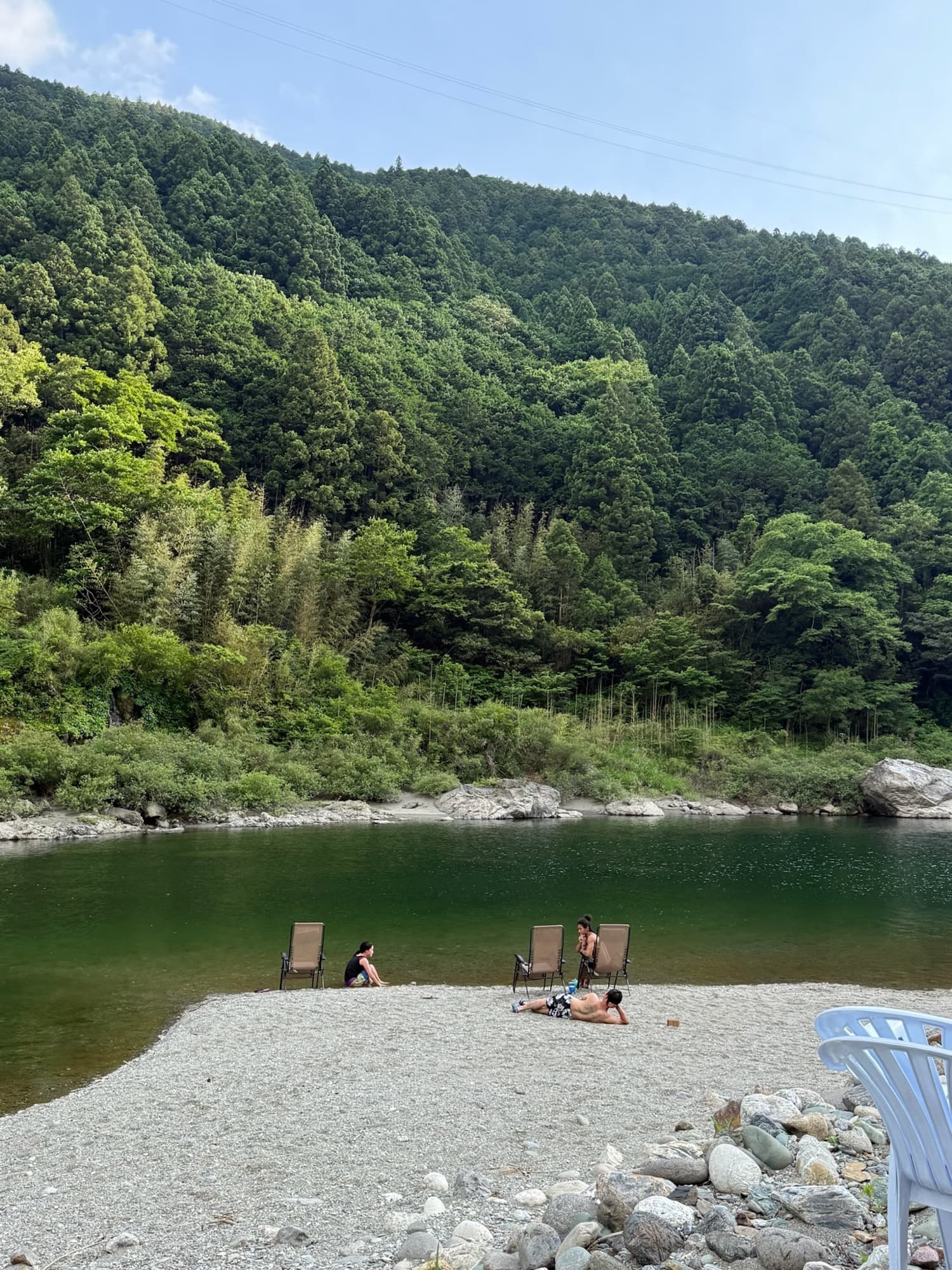
There was a stretch of the Niyodogawa bank below the bridge that had been used informally for years — swimming, fishing, the occasional barbecue — but it had never been properly maintained or made accessible. The project began with a simple question: what would it take to make this permanent?
The riverbank had no formal status. It was technically public land under the river authority, but the path down to it was steep and overgrown, the flat area near the water was uneven, and there were no facilities of any kind. People still used it — mostly families with children in summer, and a few regular swimmers who came early in the morning.
We started by documenting what was already there: the informal paths, the places where people had clearly been swimming and picnicking for years. This was useful. It told us that the space already worked — it just needed to be made more welcoming, more permanent.
The coordination involved the Niyodogawa town office, the regional river authority, and a small group of local residents who had been using the bank for decades. The bureaucratic process was longer than the physical work. River authority approvals in Japan require environmental assessments even for minor interventions. We worked with a consultant to navigate it.
The physical work so far: improved path access, removal of invasive species from the bank edge, placement of a small informational post about the river and its geology. The larger elements — a simple covered structure for shade, basic sanitary facilities — are still pending final approval.
The name came from the colour. The Niyodogawa in summer runs a blue-green that looks artificial in photographs but is entirely real. We wanted a name that was accurate, not promotional. Niyodo Blue Park is what it is.